



The Pivot to Power: Why Data Demanded the Ionic Liquid Pathway
At ELEQTRION, true scientific leadership means listening to the data—even when it changes the roadmap. In our latest R&D series, we pull back the curtain on why we shifted our focus away from aqueous (water-based) chemistry to pioneer the high-performance ionic liquid pathway for aluminium-ion batteries.
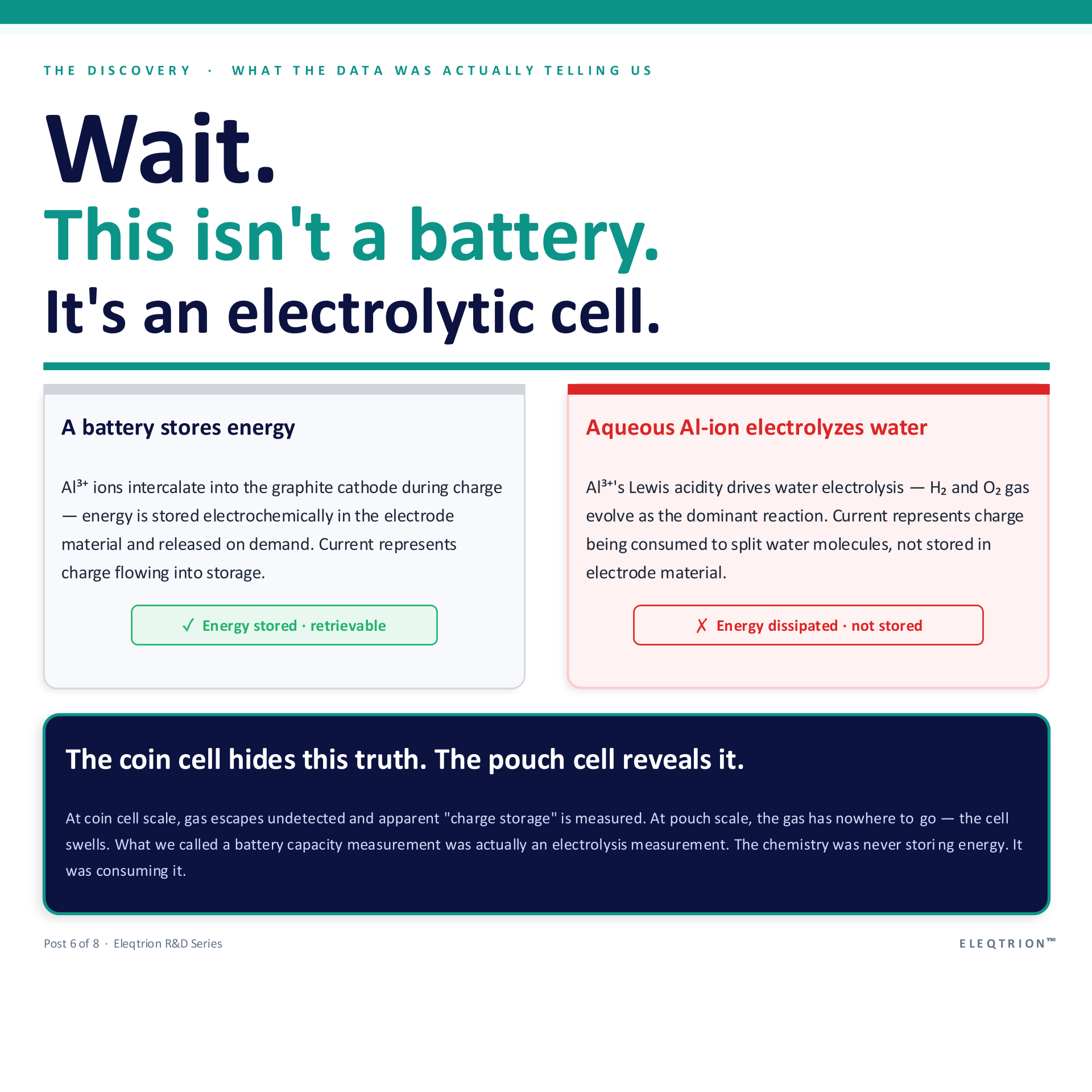
1. The Discovery: Aqueous is an Electrolytic Cell, Not a Battery
- The Illusion vs. Reality: Initial testing at the small coin cell scale hid a critical flaw because gases could escape undetected. When we scaled up to cellules en sachet (pouch cells), the reality was undeniable: the cells swelled significantly due to rapid gas evolution ($H_2/O_2$).
- Energy Dissipated, Not Stored: The high Lewis acidity of the $Al^{3+}$ ion induces severe water electrolysis. Instead of storing energy through intercalation, aqueous systems consume charge just to split water molecules.
2. The Verdict: Independent Science Confirmed the Boundary
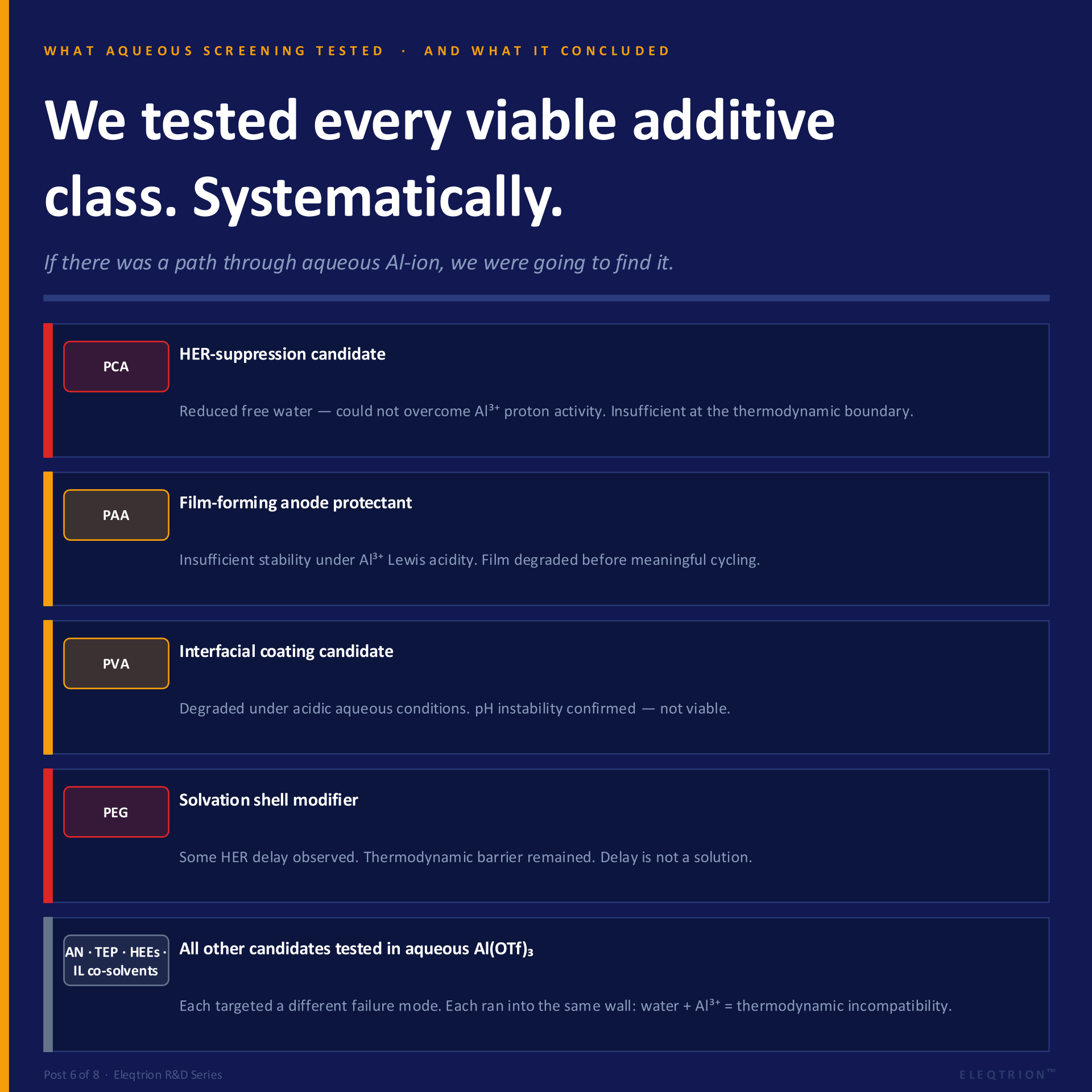
We didn’t just decide to abandon water; undeniable, peer-reviewed thermodynamics decided for us. Our internal findings were validated externally by two world-class institutions:
- U.S. Army Research Laboratory & PNNL: Confirmed that water-based aluminium chemistry faces structural thermodynamic barriers that chemistry cannot solve. Increasing salt concentrations only accelerated the Hydrogen Evolution Reaction (HER).
- Leading Canadian Public Utility Research Centre: Independently arrived at the exact same conclusion and officially recommended exploring the ionic liquid pathway.
3. The Roadmap: What ELEQTRION is Executing Now
This pivot is our single most important R&D breakthrough to date. By understanding exactly why water fails, we have built an incredibly defensible foundation for our ionic liquid electrolyte.
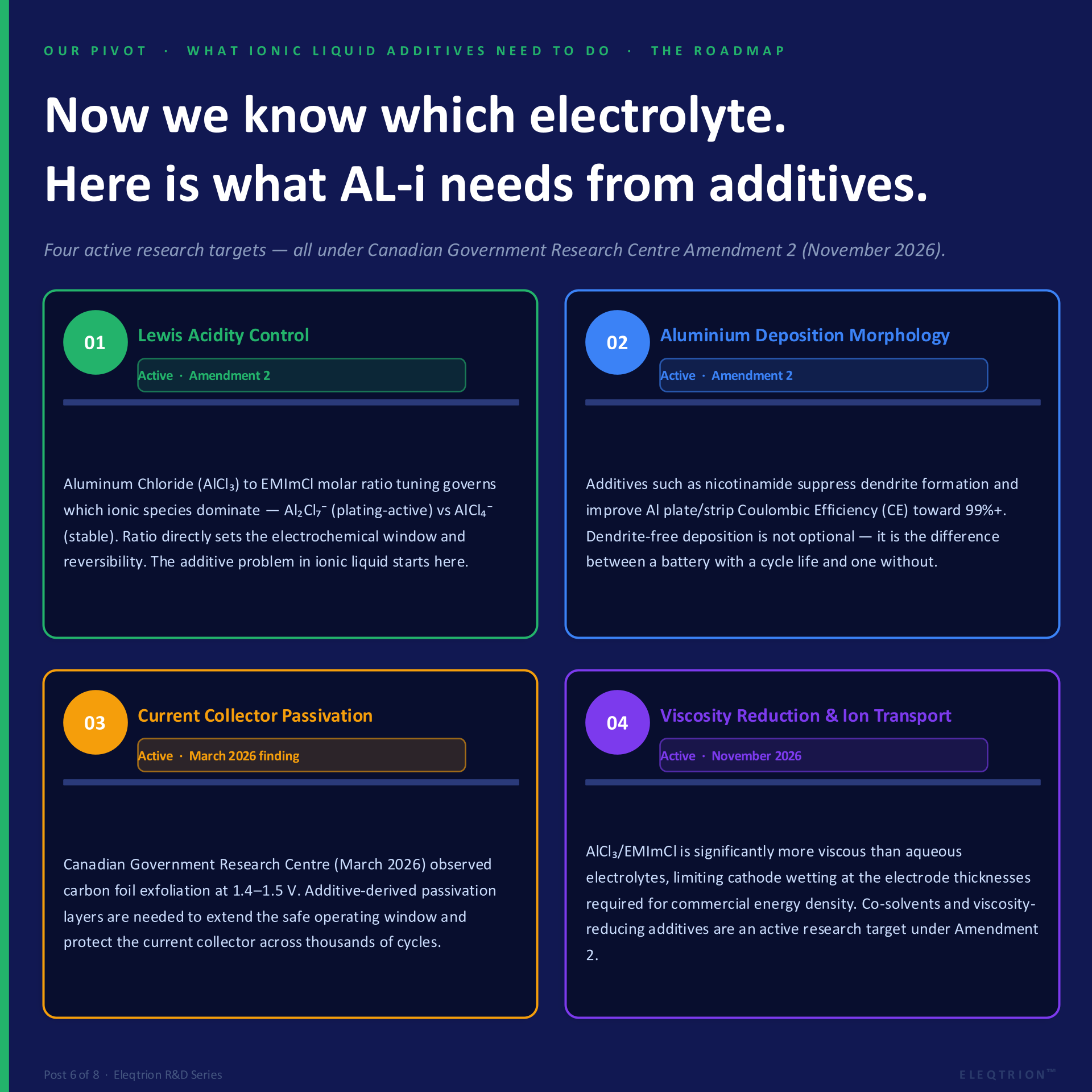
Under the Canadian Government Research Centre Amendment 2, our team is systematically evaluating four active additive targets through November 2026 to optimize commercial energy density:
- Lewis Acidity Control: Tuning molar ratios to ensure stable ionic species dominate.
- Aluminium Deposition Morphology: Utilizing additives like nicotinamide to suppress dendrites and push Coulombic Efficiency toward 99%+.
- Current Collector Passivation: Implementing protective layers to stop carbon foil exfoliation and ensure thousands of safe cycles.
- Viscosity Reduction & Ion Transport: Deploying co-solvents to improve cathode wetting.
The Conversation About What Comes After Lithium Starts Here.
We are actively collaborating with industrial and academic partners on battery procurement, supply chain integration, and technology licensing.
Contact: William Reynolds www.eleqtrion.com/contact

